

Security First, Shoppers Second
The Crime Levy
Retail theft in the UK has reached a staggering £2.2 billion a year, according to the British Crime Survey for 2024/2025. That’s over 20 million incidents annually or roughly 55,000 thefts every day. For the shopper, it’s a crime tax of 0.5% added to every transaction to cover the cost of stolen stock
While the industry debates the causes, the shopper is left living with the consequences
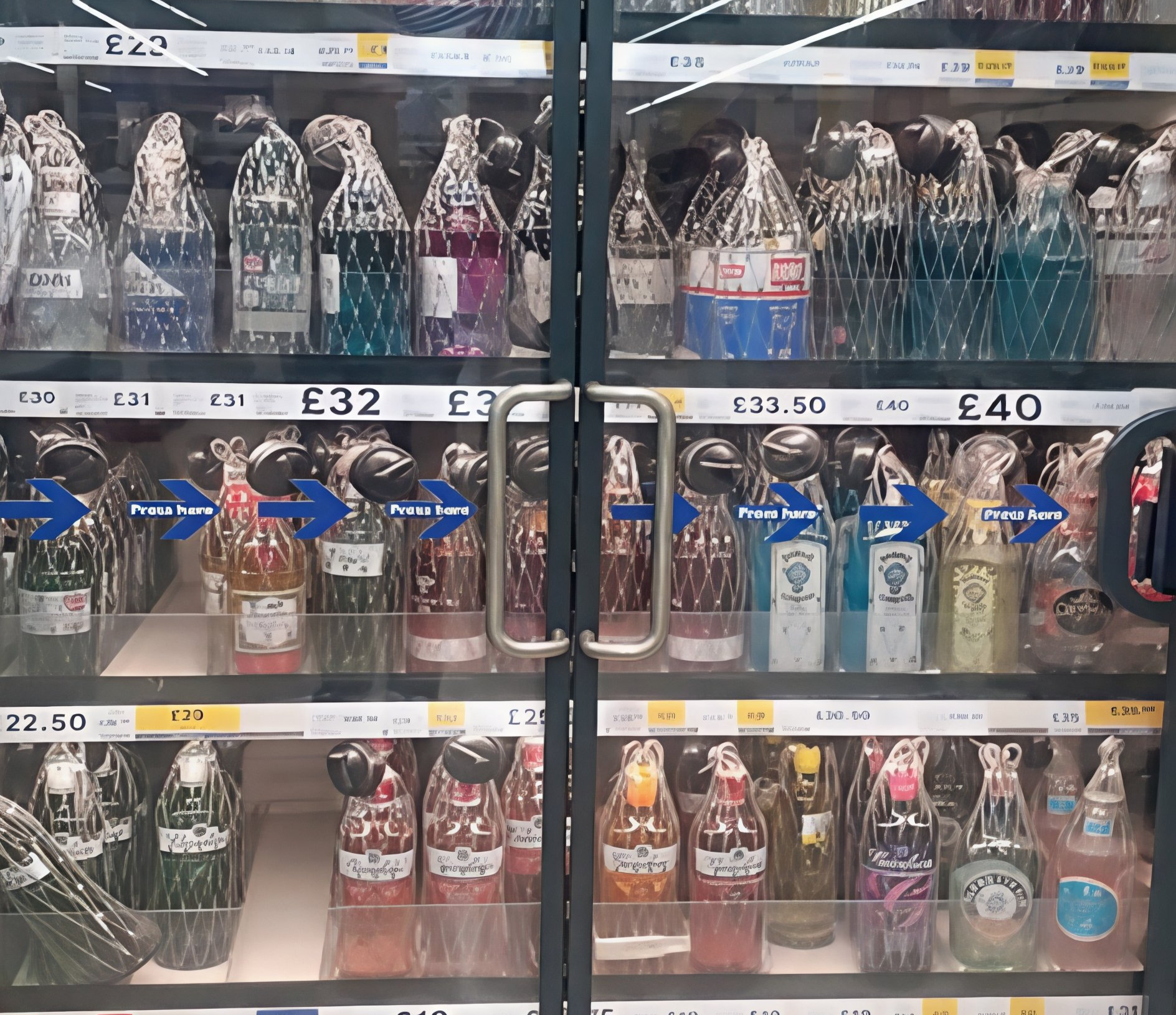
The retailer has responded with a landscape of security tags, mesh netting and locked fridges. Whilst brands maybe able to operate within the confines of one measure, increasingly there are having to contend with 2 or 3 obstacles. Brands are operating in a heightening world of major barriers to choice and discovery
Spirit Brands Behind Bars
Mesh netting might reduce risk for the retailer, but it creates a real impact for the consumer. It places a physical strain on anyone trying to read a label or compare products.
In the high-ticket spirits category, security tags are now also standard. While a minor frustration at checkout, they are secondary to the impact of locked fridges. These barriers reduce browsing and encourage price labels to become the primary source of identification. The brand is no longer the hero.
These fridges are often timed. If a shopper takes too long to navigate the clutter, they risk sounding an alarm. It is a high-pressure environment for a low energy brain. If the shopper cannot see the distinctive assets that justify a premium, the transaction becomes a commodity exchange based on price.
Distinctive assets are the mental shortcuts that drive selection. When a brand is wrapped in mesh, these assets, and associated advantages, are lost
The brand must now adapt to a landscape of negative friction. It must still find a way to disrupt, provide clarity and convince
The New Realities
For the Shopper The aisle is no longer a place of discovery. When security measures prioritise stock over experience, the shopper defaults to the path of least resistance. This usually leads to a quicker exit and a smaller basket. The joy of browsing the category is replaced by the relief of finishing the mission or bypassing altogether. In the spirit world the experience risk is becoming like buying tobacco with all the restrictions in visibility and choice that has become the norm in the UK
For the Brand Physical barriers act as a filter on brand equity. If the distinctive assets are obscured by mesh and glass, the brand loses the ability to justify a premium, or justify a new choice. The brand must now work harder to be mentally available before the shopper enters the store. Relying on on-pack disruption at the shelf is no longer a given strategy when the shelf is in solitary confinement
For Shopper Insight Measuring intent in a sterile environment is a wasted exercise. Research must replicate the high pressure and bad friction of the changing store to be valid. Testing must account for the cognitive drain of obscured visibility and the potentially the desire to request for doors to be open. If the methodology acknowledges these barriers, insight is reflective of an evolving retail world
Insightful research works with the reality of the changing demands at shelf
The Illusion of the Clean Test
There is a natural desire to test new packs and positions in a clean environment. This allows for a pure measurement of a brands distinctive assets and its potential to disrupt. However, a clean test measures a brand in a vacuum that doesn’t necessarily exist in the modern store. While providing clear data, it risks overestimating the brands performance in the face of real world friction
Conversely, reflecting the total mess of reality in every test is not always the answer, but the acid test. Total reality can be too noisy to identify which specific design elements are failing. The goal is not to choose one over the other but to understand the gap between them. We must counterpoint the potential of the pack in a controlled space with its performance under pressure. In the case of the evolving spirits fixture, under the barriers of mesh netting, security alarms, timed access, etc.
At the very least, it’s a discussion that must reach the table. When the reality of shopping is messy, surely it’s better to face-into the reality to establish the job to be done
The Best of Both?
Ideal research works with the reality of a changing shelf. We can broker the two realities by linking online shelf recreation with physical shop-a-longs. Online environments allow us to isolate the power of distinctive assets and measure the pure potential of a pack to disrupt. We can then pressure test these findings through shop-a-longs in high friction environments
By observing a shopper navigate a timed fridge or struggle with mesh netting in person, we see exactly where the potential of the pack is lost to the reality of the cage. This dual approach identifies not just how a brand should perform, but how much equity is being compromised by physical barriers of the aisle